
12 May 2026 / 4 ግንቦት 2018
It is with great pleasure that I wish to convey my appreciation to the King’s Own Royal Regiment Museum for this act of restitution and restoration that is being carried out today. I would also like to thank Dr. Robin Jackson, chairman of the Museum Trust, for his kind invitation to attend this occasion. I regret that I am unable to attend in person, but I extend my thanks to Dr. Jackson and the Museum Trust.
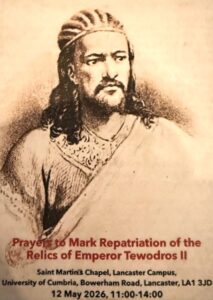
These relics of Emperor Tewodros II that are being handed to representatives of the Ethiopian Heritage Authority today are more than just a simple case of human remains being returned to their place of origin. Tewodros II represents an ideal of Ethiopian nationhood, of patriotism and national pride that still speaks to Ethiopians today. His vision of unity and development was perhaps way ahead of his time in the Ethiopian context, but his efforts resulted in the strengthening of Ethiopian unity and prepared it for the coming challenge that was European colonialism on the African continent. If it were not for Tewodros II, Ethiopia would not have had the strength to maintain its independence and sovereignty to the present day. Therefore, these relics of Tewodros II have immense meaning for all Ethiopians and indeed Africans.
This act is one that honours the long ties of friendship between Ethiopia and the United Kingdom. Although we faced each other across a battlefield in 1868, our two nations have enjoyed ties of friendship since then. Indeed, it is to be remembered that British forces played the key role in ending the occupation of Ethiopia by fascist Italy in 1941, which made Ethiopia the first country freed from occupation by the Axis Powers in World War II. Acts such as this handover today only serve to strengthen our ties of friendship.
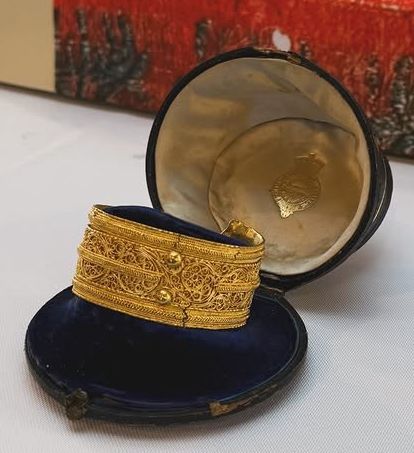
The possession of historic items by institutions and individuals far from their origins is a delicate topic which continues to raise passions and rhetoric in our present day. The issues of preservation, heritage restitution and restoration, and property rights will continue to be contentious ones. However, in recent times we are seeing increasingly that a spirit of cooperation is emerging to find ways to bridge the gaps and come up with solutions. These are not isolated acts, but part of a larger movement grounded not in division, but in understanding. Not in accusation and recrimination, but in collaboration and cooperation. The return of these sacred and historical relics to the National Museum of Ethiopia by The King’s Own Royal Regiment Museum is a powerful affirmation: that history, when approached with integrity and goodwill, can become a bridge rather than a barrier. Today we are building yet another bridge between our nations, our institutions, and between our peoples.
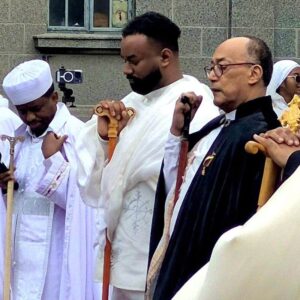
I would like to extend my deep appreciation to Professor Abebaw Ayelew of the Ethiopian Heritage Authority, and Professor Alula Pankhurst who are receiving these relics and who work tirelessly to preserve our national heritage. I also want to extend special thanks to Father Abate Gobena, PhD of the Ethiopian Orthodox Tewahedo Church who is here to bless these relics of our revered Emperor. The Ethiopian Orthodox Tewahedo Church has served as the repository of our heritage for centuries, and so it is only appropriate that it is represented here and gives its blessing.
It is my sincere hope that the work we continue to undertake together will ensure that future generations of Ethiopians – and indeed, all people – may encounter these artifacts not as distant relics, but as living connections to a shared human story.
May this moment serve as a reminder that through partnership, respect, and a shared commitment to truth, we can restore not only objects but also dignity, heritage, and mutual understanding.
Thank you all,
Prince Ermias Sahle-Selassie Haile-Selassie
President of the Crown Council of Ethiopia
Patron of the Royal Ethiopian Trust