Royal Ethiopian Trust Garners International Media Attention

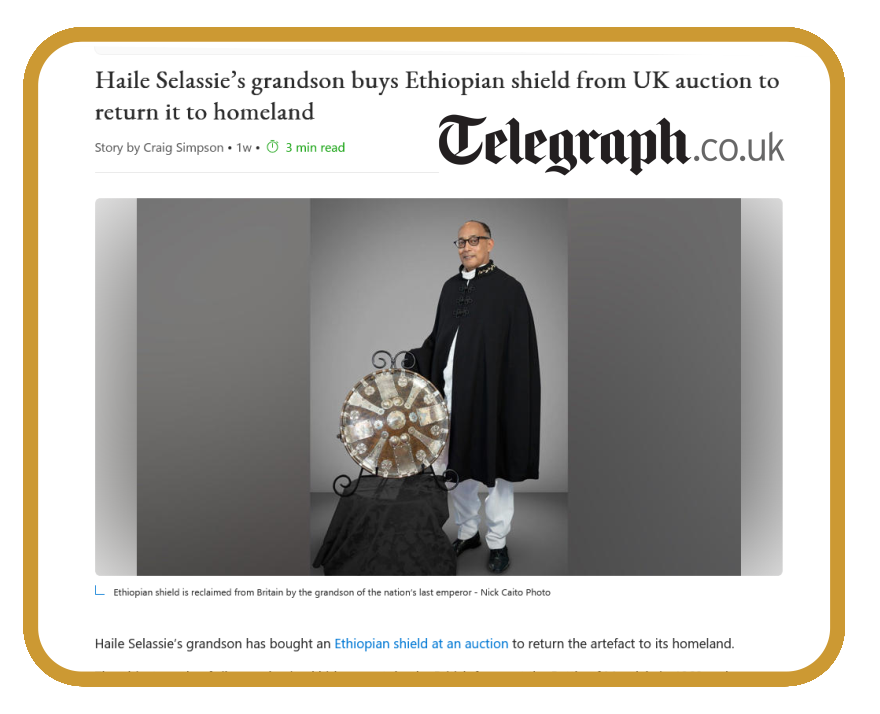
The Magdala Shield

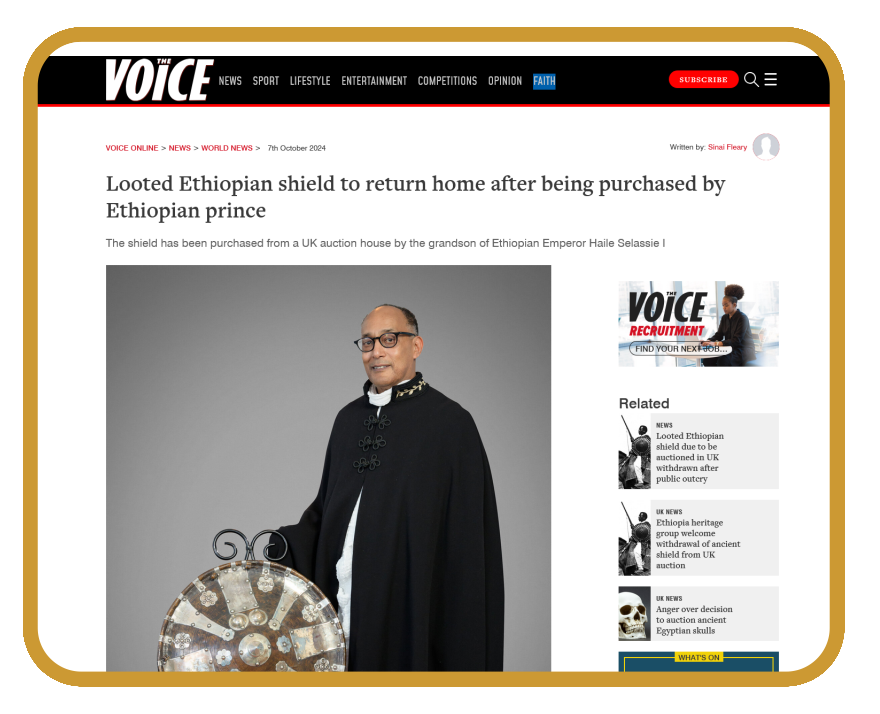
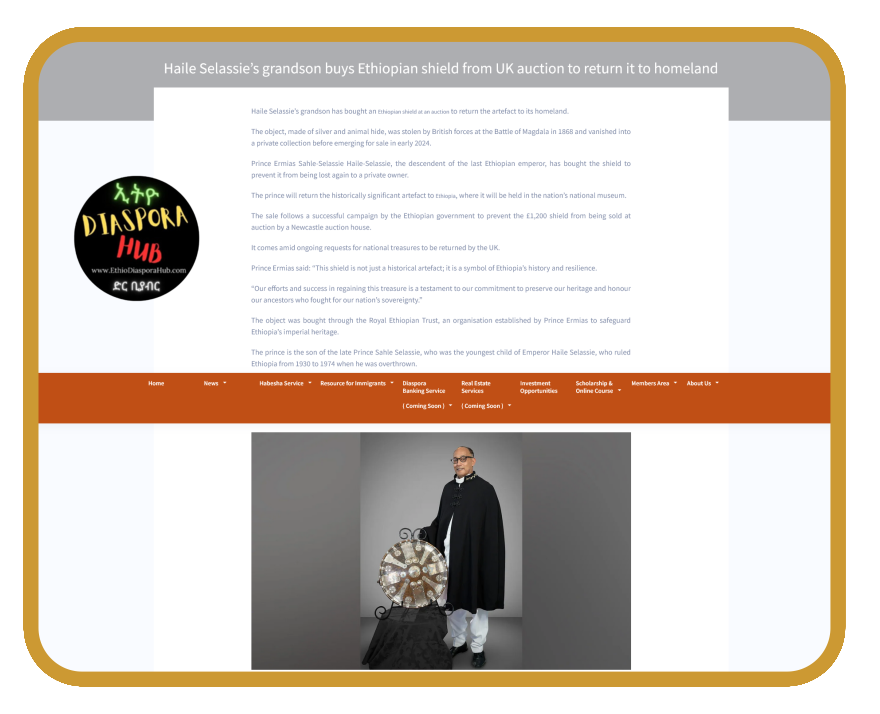
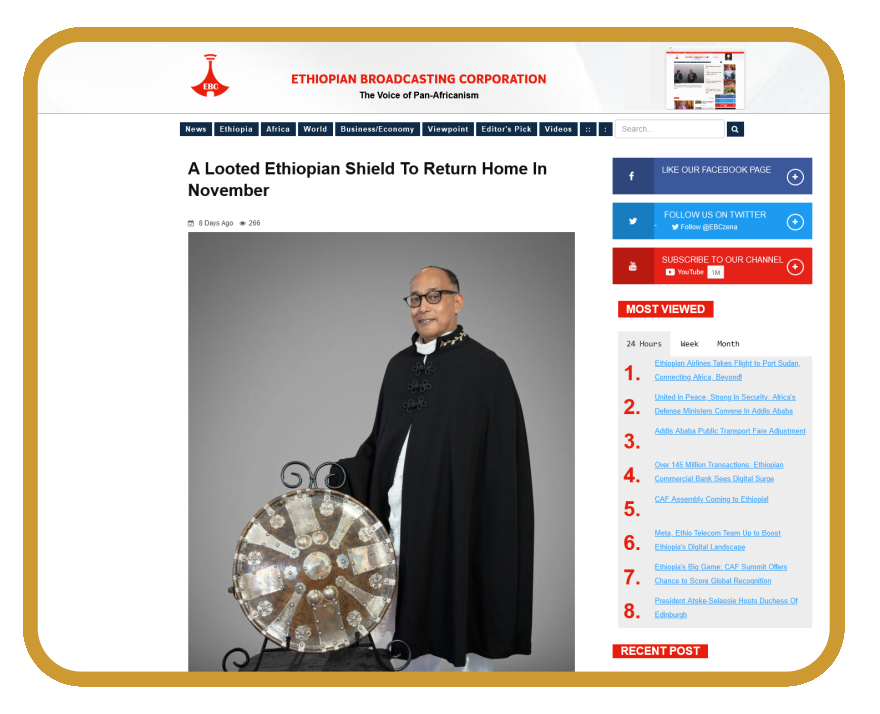
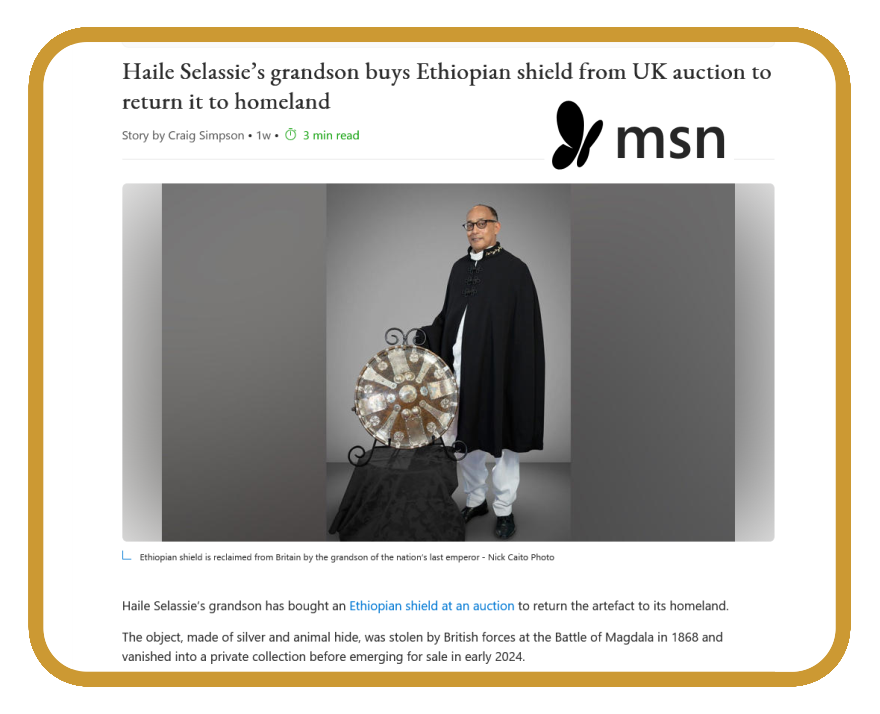
HIH Prince Ermias Sahle-Selassie Haile-Selassie and The Royal Ethiopian Trust Negotiate the Return of Historic Shield from the Battle of Magdala

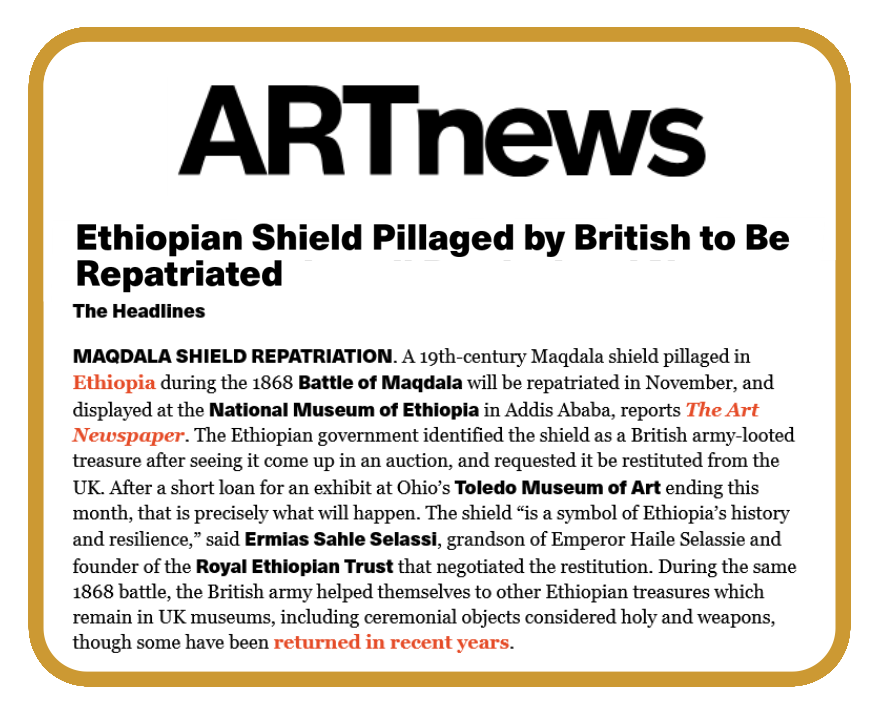
The return of The Magdala Shield has attracted worldwide press coverage.

Per the press release from The Royal Ethiopian Trust:

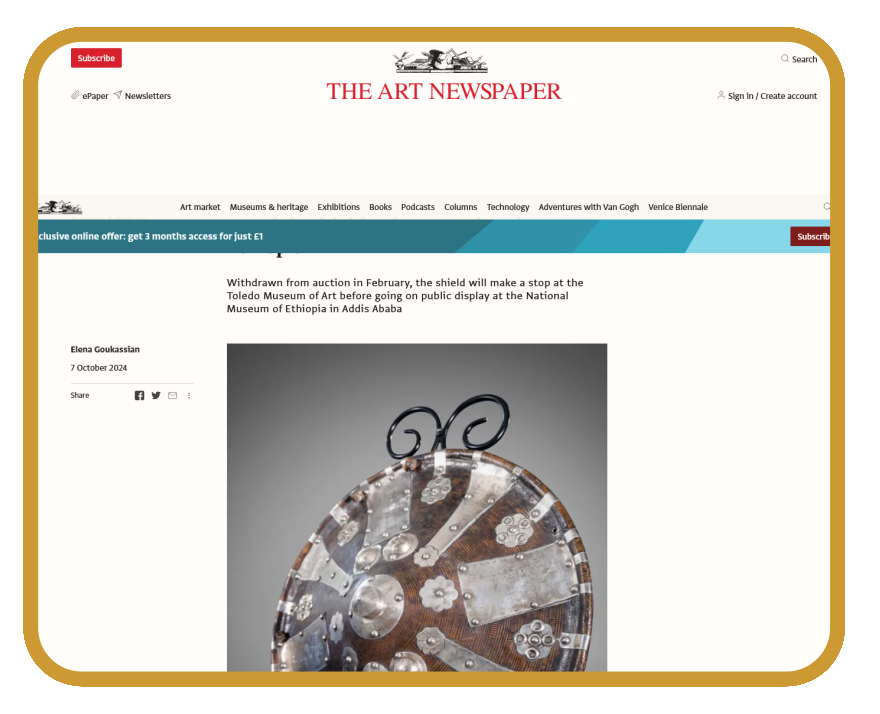
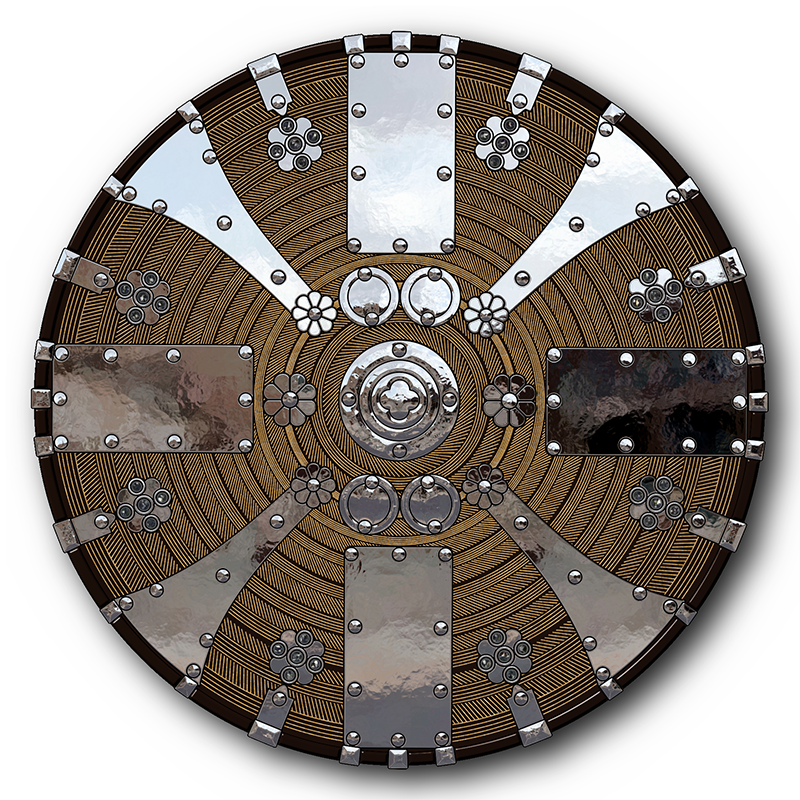
The Magdala Shield
The Magdala Shield
[Artwork: David Robert Wooten, GCEL, KCSE]

“The shield, one of numerous artifacts seized by British troops following the battle of Magdala in 1868, holds immense cultural value, and was acquired through negotiations with the UK-based Anderson & Garland auction house. The shield had been slated for public auction in February, but was withdrawn following pressure from the Ethiopian government.  Under Prince Ermias’ direction, the RET took proactive steps to negotiate the shield’s return to Ethiopia, in keeping with the organization’s mission to protect and celebrate the nation’s cultural treasures.

“‘This shield is not just a historical artifact; it is a symbol of Ethiopia’s history and resilience,’ said Prince Ermias. ‘Our efforts and success in regaining this treasure is a testament to our commitment to preserve our heritage and honor our ancestors who fought for our nation’s sovereignty.'”

For complete details on this and other projects visit The Royal Ethiopian Trust website.

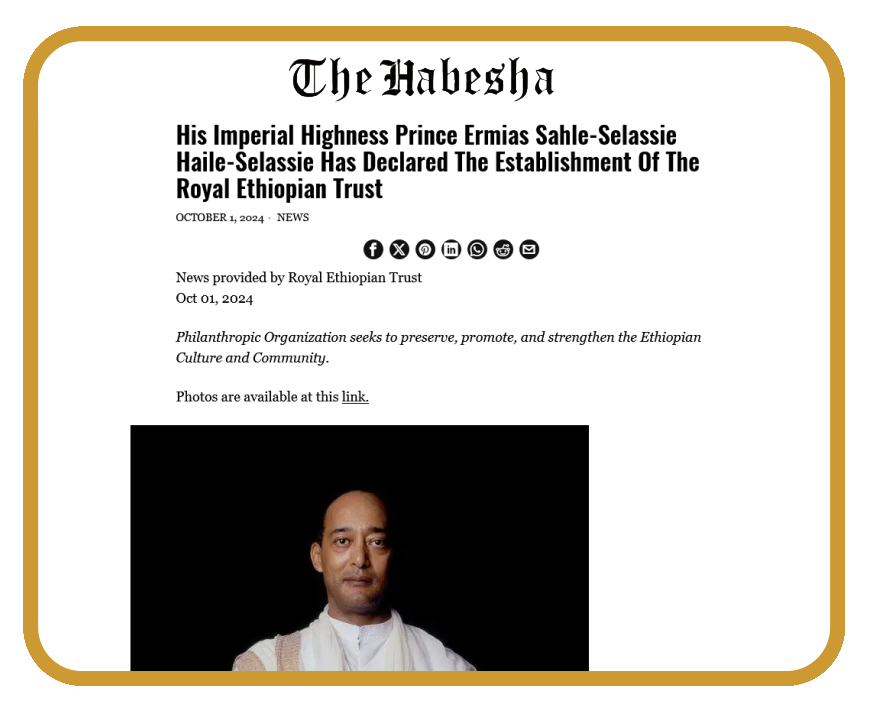
His Imperial Highness Prince Ermias Sahle-Selassie Haile-Selassie Announces the Formation of the Royal Ethiopian Trust

His Imperial Highness Prince Ermias Sahle-Selassie Haile-Selassie Announces the Formation of the Royal Ethiopian Trust

1 October 2024

THE ROYAL ETHIOPIAN TRUST

Philanthropic Organization seeks to preserve, promote, and strengthen the Ethiopian Culture and Community

His Imperial Highness Prince Ermias Sahle-Selassie Haile-Selassie today announced the formation of the Royal Ethiopian Trust (RET), a 501(c)(3) organization established to advance the legacy of the Ethiopian Crown and promote the cultural, educational, and economic well-being of all Ethiopian people.

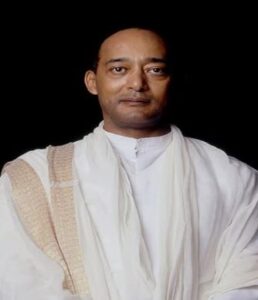
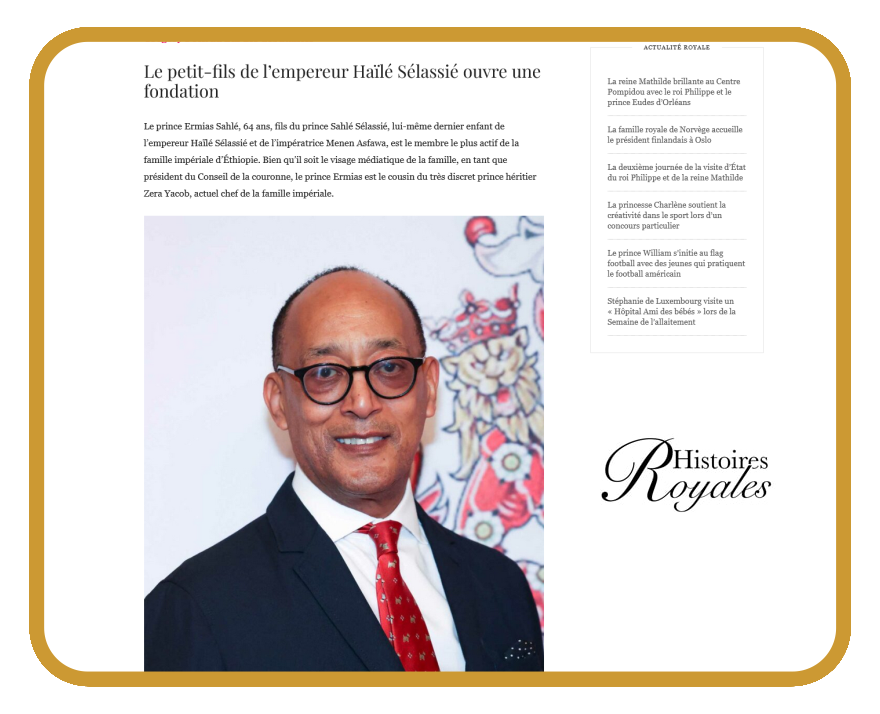
His Imperial Highness Prince Ermias Sahle-Selassie Haile-Selassie

HIH Prince Ermias Sahle-Selassie Haile-Selassie
President of the Crown Council of Ethiopia
HIH Prince Ermias Sahle-Selassie Haile-Selassie, President of the Crown Council of Ethiopia

Prince Ermias, grandson of His Imperial Majesty Emperor Haile Selassie I, represents the longest unbroken royal lineage in history, dating back 3,000 years. He and his family were exiled in 1974 when the Communist revolution deposed and assassinated then Emperor Haile Selassie. Educated at the University of California at Santa Barbara and the Fletcher School of Law and Diplomacy, Prince Ermias was appointed President of the Ethiopian Crown Council in 1993. He has remained an active steward of Ethiopia’s rich heritage from his home in the United States.

“The Royal Ethiopian Trust has been a long time in the making, and I am deeply thankful for the counsel and support we’ve received,” said Prince Ermias. “I look forward to working with our partners around the world to unite Ethiopia’s past and future, preserve our imperial heritage and foster progress for all Ethiopians.”

Prince Ermias also expressed gratitude to those who have accepted positions on the Trust’s founding Board of Directors. These individuals bring decades of entrepreneurial and philanthropic experience, along with close ties to the Ethiopian Royal Family and the Ethiopian Orthodox Church. The Board will assist the RET in remaining operationally strong and focused on its mission.

The Royal Ethiopian Trust is structured around four core pillars that reflect its mission to safeguard Ethiopia’s cultural and historical heritage while fostering progress and unity:

  • Empowering Ethiopia’s Future through Education
  • Fostering Ethiopian Entrepreneurship
  • Preserving Ethiopia’s Imperial Heritage
  • Supporting the Ethiopian Crown

“With these pillars as our foundation, the Royal Ethiopian Trust is dedicated to the prosperity, cultural vibrancy and unity of Ethiopia,” said Deacon Solomon Kibriye, who has been appointed President of the RET. “We are committed to making a lasting impact that reflects the enduring spirit of Ethiopia.”

About the Royal Ethiopian Trust
The Royal Ethiopian Trust is a registered 501(c)(3) not-for-profit organization founded by His Imperial Highness Prince Ermias Sahle-Selassie Haile-Selassie, dedicated to preserving Ethiopia’s rich cultural heritage and empowering its future. The Trust operates on four fundamental pillars: empowering youth through education, fostering entrepreneurship, preserving Imperial heritage, and supporting the Ethiopian Crown as a unifying symbol of national identity. Through these efforts, the Royal Ethiopian Trust seeks to ensure the prosperity, cultural vibrancy, and unity of Ethiopia and its people.

Prince Ermias Sahle Selassie and his delegation visit Hungary

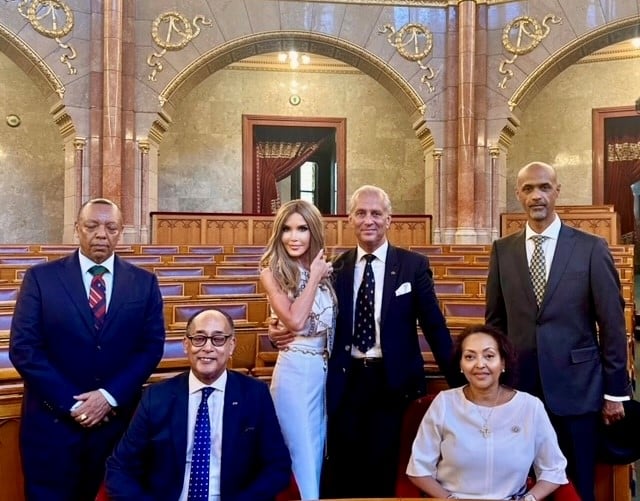
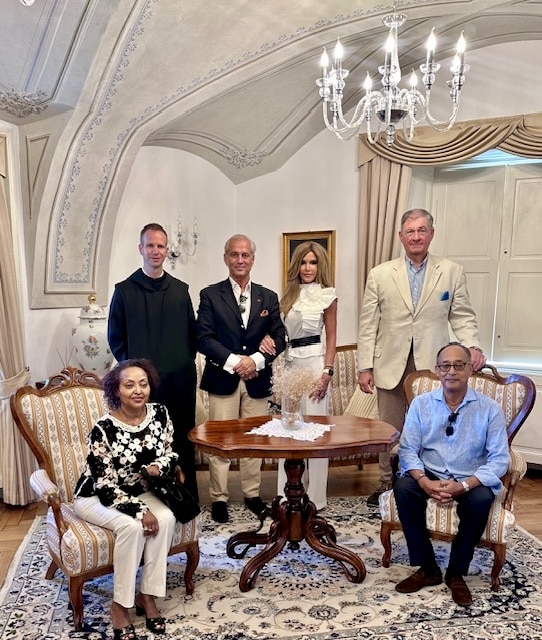
Prince Ermias Sahle Selassie recently completed a formal visit to Hungary from August 18 to August 23, 2024. The President of the Crown Council, HIH Prince Ermias Sahle-Selassie, visited Budapest accompanied by a delegation including HIH Princess Saba Kebede, lij Anania Abebe, and lij Yitayil Berhanu. The visit included a series of formal events, ceremonies, and social activities.

(l-r): lij Yitayil Berhanu; HIH Prince Ermias Sahle-Selassie; Mrs Agnes Berniczei-Royko; Dr Adam Berniczei-Royko; HIH Princess Saba Kebede; lij Anania Abebe

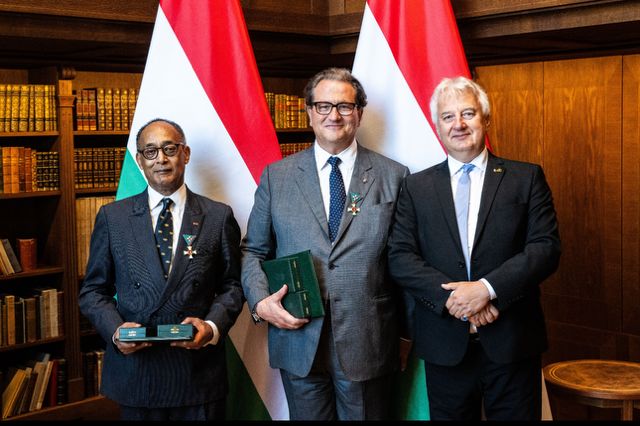
The delegation received a warm welcome by local hosts and visited the Hungarian Parliament,. They later attended an inauguration at the Royal Castle of Buda. The ceremony, held in the historic Habsburg family crypt, was one of the highlights of the visit, including a state honours ceremony and champagne toast. Zsolt Semjén, the Deputy Prime Minister of Hungary, presented Prince Ermias with the Hungarian Order of Merit Commander’s Cross in recognition of his work for the promotion of Christian values between the two countries and for working to enhance Hungary’s good reputation. This presentation was accompanied by the investiture of the Deputy Prime Minister of Hungary with the Grand Collar of Ethiopia’s Order of the Trinity, The day concluded with a gala dinner at the Carmelite Monastery hosted by Deputy Prime Minster Zsolt and his wife and prominent Hungarian dignitaries.

The subsequent days were filled with rich cultural experiences. On Hungary’s National Day, the group attended a Holy Mass at St. Stephen’s Basilica, followed by a procession and an evening fireworks display viewed from the Carmelite Monastery. A trip to the Tihany Abbey and a boat tour on the Danube River rounded out the midweek activities. The visit culminated with a farewell dinner hosted by Dr. Ádám Berniczei-Roykó, providing a final opportunity for participants to exchange diplomatic gifts before departing Budapest on August 23rd. Upon returning from Budapest, Prince Ermias reported to supporters of the Ethiopian Crown that “The trip not only honored historic ties between Ethiopia and Hungary but also deepened diplomatic and cultural relations.”

He also stated that “there will be ongoing initiatives and work in the fields of education and cultural conservation.”

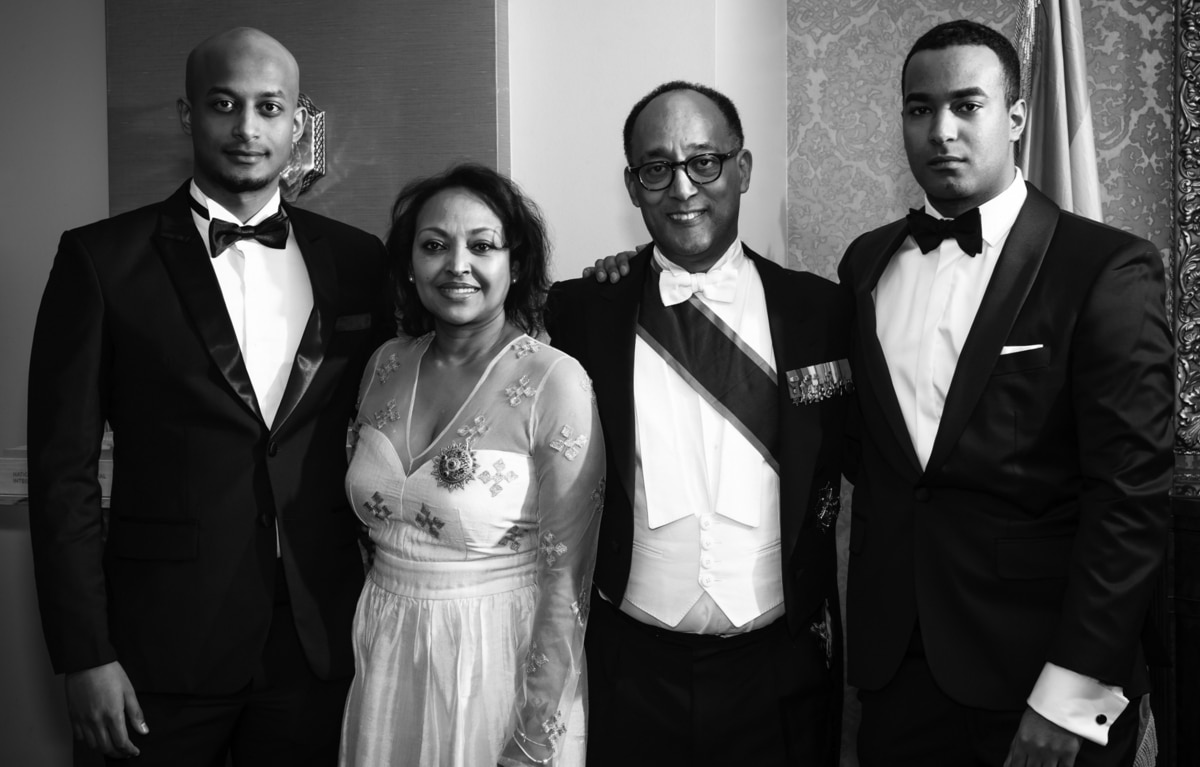
2024 Victory of Adwa Dinner

The Annual Victory of Adwa Dinner for 2024 was held 23 March 2024 in Washington, DC.

Click the photograph above to be taken to the website of the photographer who captured the event.

Proceeds from the sale of photographs on this website – which also includes photos from the 2019-2023 Victory of Adwa Dinners – will go to support The Crown Council of Ethiopia.

An End to a Half Century of Massacres

A Statement from HIH Prince Ermias Sahle-Selassie Haile-Selassie

President of the Crown Council of Ethiopia

የካቲት 20, 2016 / February 28, 2024

We, the Crown and People of Ethiopia, have endured our portion, and more, of the massacres of our kinsmen, by our kinsmen, over the past half-century. We can tolerate no more.

The latest known massacre, one-by-one in execution style, was of at least 102 innocent civilians — from infants to the most elderly — in the town of Merawi, in the Gojjam Region, on ጥር 20, 2016 (January 29, 2024, international calendar), by a uniformed battalion of the Ethiopian National Defense Force. This deliberate, savage, and unwarranted massacre took us past our final barrier of tolerance. The only crime of the people of Merawi that day was that they were Amhara, of Christian and Muslim faiths, and their attackers were primarily not representative of what a national army should be; they were led and largely manned by Ethiopians of a different ethnicity.

We have witnessed a nightmare of unconscionable and frequent massacres over the past year: perhaps as many as a million people have been killed, and countless more rendered homeless. In the two years before that we saw even more killed in inter-ethnic warfare, by both extremist ethnic groups and the government of the day.

Our stable, peaceful, and rapidly-progressing society was shattered on መስከረም 2, 1967 (September 12, 1974), when a coup by a small group of military overthrew the Emperor, His Imperial Majesty Haile Selassie I; later to kill him, and to instigate the first of the massacres: the Massacre of the Sixty. That occurred on the morning of ኅዳር 14, 1967 (November 23, 1974), and saw 60 imprisoned former government officials executed by the coup leaders — the Dergue — at Kerchele Prison. It began the Soviet-supported communist Red Terror and the Ethiopian Civil War, neither of which, arguably, have yet ended. Many members of the Ethiopian Imperial Family were either killed or imprisoned for decades.

These past 50 years have seen the Terror take from all Ethiopians their illustrious historical identity as Ethiopians when these revolutionaries have attempted to divide us in order to conquer us. We have been robbed, too, of our lands and properties, of our rights to our self-defence, our freedom, and — for a half-century — we were robbed of our future. No more. We can no longer allow others to impose identities upon us. We are, as the Gift of God, free people who also have been known as Ethiopians and kinsmen to each other across all regional lines.

The repudiation of this 50-year reign of terror, imposed over several different administrations, is well underway, as the uprising of Ethiopian peoples of many ethnicities and regions occurs to seek justice. But this can only be justice if the rule of legitimate laws is restored. We cannot replace violence and injustice with a different variation of violence and injustice.

The Ethiopian Crown was never destroyed during these past 50 years, and it is ready, as always, to help restore peace, justice, and friendship among all Ethiopian Peoples. And we urge the Fano groups of militias which have arisen around our nation to remain conscious that their mission is to restore justice and accountability; to restore the unity and prosperity of our various peoples; and not to seek vengeance.

The adoption of the 1966 (1974), draft Constitution, proposed by Emperor Haile Selassie, is critical to us today. It alone can create the legitimacy of governance required to impartially achieve justice for victims of Merawi and the Sixty, and the millions of our dead, displaced, and impoverished in the intervening half century.

We must memorialise this half-century of tears; this half-century of wasted time and wasted lives; this half-century of unwavering nobility of suffering by our People. And we will do so, just as we have memorialised the great triumphs of our united People during the two great Italian invasions and the many invasions by regional forces. We must recall that the great Emperors, Menelik II and Haile Selassie I, began putting Ethiopia on the path to economic and social progress. And this progress was interrupted solely by the greed for power of individuals whom history will forget.

It must now be our common goal to end the present conflict with as little bloodshed as possible, and commit ourselves to being above revenge and in favour of impartial justice. And to seeing not only the restoration of a trustworthy democratic process, but the dawn of an era when our interrupted path to prosperity and prestige is resumed.

God Bless Ethiopia! May it become, again, a nation of peoples committed to justice.
A Call for Ethiopia’s Salvation

From HIH Prince Ermias Sahle-Selassie Haile-Selassie

President of the Crown Council of Ethiopia

Victory of Adwa Day, የካቲት 22, 2016 (March 1, 2024)

Ethiopian Brothers and Sisters: We are at the pivotal point between a future of perpetual darkness, or a future of revived happiness, pride in our unique identities, and conscious of our historical role which makes us unique in a world in turmoil. We cannot sleep through this time, nor allow our fate to be decided by those who wish our destruction and would see our three millennia of striving at God’s hand become scattered, meaningless, and lost.

The fate of what we know as Ethiopia is now in your hands. Our hands: the joined hands of the Ethiopian peoples and the Crown of Ethiopia.

Beloved Ethiopia! Beloved Ethiopians! Today we raise our prayers in thanks for the great victory of Adwa, delivered to us 128 years ago by Emperor Menelik II and Empress Taitu Betul and the united Ethiopian People against the first Italian invasion. The Crown Council struggled for decades to have the great, unifying Victory of Adwa officially recognized and memorialized, and our efforts proved impossible to ignore. The Ethiopian People are thus restoring their memory and their identity. To lose our way again would prove fatal. Our prayers similarly thank the Almighty for the great victory 83 years ago by Emperor Haile Selassie I and the united Ethiopian People — the Arbegnoch, the Patriots — against the second Italian invasion.

But today our prayers are also prayers of anguish, trauma, and supplication for deliverance and guidance in dealing a threat which may end the unbroken pride and identity — indeed, the very existence — of Ethiopia. It is a threat from within our great empire of equal peoples, and, yes, the current war which takes or brutalizes so many Ethiopian lives is either supported or ignored by so many of the world’s peoples. Left unremedied, this current war will transform our lands from a divine land of promise to a landscape of salted soil and perpetual sorrow.

The Crown of Ethiopia has endured, rebuilt, and strengthened since the coup a half-century ago saw not only the death of our beloved Emperor Haile Selassie but also the very deliberate killing of the great new Constitution which was to have delivered Ethiopia into a new age of freedom, democracy, opportunity, and guaranteed equality under the law.

Beloved Ethiopians! Those great emperors who gave us salvation at Adwa and Gondar are gone in body, but not in spirit. Nor are they gone from memory. Neither are they lost to us as inspiration. Thus they are alive, and the Solomonic Crown today pledges to work beside you all to resolve our present miseries and deliver safety, happiness, trust among our peoples, freedom to pray each in our own ways, and the restored prestige of Ethiopia as a light to the entire world.

If the tools to end our present tragedy are in our hands, then it is true that to take them up will require the humility of greatness to enable compromise and the leap of faith to rebuild trust.

There is no doubt that it will also require, as the guiding plan, the implementation of the ሐምሌ 30,  1966  (August 6, 1974, International Calendar: IC) draft Constitution, which would provide for the restoration of the legitimacy of Ethiopian governance as well as the restoration of the rule of democracy and safety under the law.

The Crown, embodied in the Crown Council of Ethiopia under the last legitimate Constitution of Ethiopia, is here to provide the bridge between the warring parties and to restore the peace of the family. It is not the Crown’s right, under the 1966 (1974 IC) Constitution, to interfere in the rights and duty of Ethiopians to elect their own parliament and government, but it is the Crown’s duty to protect the Constitution and the constitutional rights of Ethiopians. Therefore, we are available to help our warring society to resolve its differences by whatever means possible.

Beloved Ethiopians! It is a time for the great among our people to come forward and show their strength through compromise and obedience to the Almighty and to the larger destiny of the Ethiopian nation-state, and its sparkling component nations. It is a time for all Ethiopians to insist on the dignity, equality, and opportunity of all our peoples and to have justice before God and the world.

It is a time to return to our challenge of setting to the entire world, once again, an example of ethical and moral devotion. To become, once again, the noble state.

On the Passing of Vittorio Emanuele of Savoy, the Prince of Naples

The Ethiopian Crown Council extends its condolences to the House of Savoy and the people of Italy on the passing of Vittorio Emanuele of Savoy, the Prince of Naples (1937-2024). Prince Ermias Sahle-Selassie, President of the Crown Council, said, “I am sorry to learn of the death of the Prince of Naples. His family and mine shared the challenge of exile from our homeland, and the struggle of waiting many decades before being able to return. I extend my sympathies in particular to his widow Princess Marina, his son Emanuele Filiberto the Prince of Venice, and his two granddaughters, Princess Vittoria and Princess Louisa of Savoy.”

His Royal Highness Prince Vittorio Emanuele of Savoy was born on February 12, 1937, to the then Crown Prince (later King) Umberto and his wife Princess (later Queen) Marie Jose (born a Princess of Belgium) in Naples, Italy. He went into exile with the rest of the Italian Royal family when the Italian monarchy was abolished in 1946, and along with all males of his family was prevented by law from setting foot on Italian soil.  The Italian Royal Family were made to bear the burden of punishment that should have been directed at the members of the Fascist Party who committed the crimes, but who were instead shielded from punishment. The law excluding the Savoy Princes from their homeland was repealed in 2002, and Prince Vittorio Emanuele was able to return to his homeland along with his family.

Reflecting on Vittorio Emanuele’s long life, Prince Ermias said, “In 1946, when the Prince was still a young boy, the Italian people voted to abolish their monarchy. In doing so, they forgot that their monarchy had made Italy. The monarchy was the symbol that unified the Italian nation, making many regions and principalities into a single people. Here too, his family and mine have played comparable roles, the Ethiopian monarchy being central over the centuries to the creation and preservation of Ethiopian unity. Ethiopia and Italy have met in war twice in the past, but these are brief moments in the long history of two great nations. The Prince of Naples was open and sympathetic to the idea of an apology from the House of Savoy to the Ethiopian people for the conflicts of the past. I look forward to working with his heirs to heal this intergenerational wound, to preserve our cultural heritage, and to advance the cooperation between our peoples.”

Palm Beach Freedom Institute Celebrates 80th Anniversary of the Holy Trinity Cathedral in Addis Ababa

Prince Ermias Sahle-Selassie would like to thank his good friend and colleague Paul du Quenoy of the Palm Beach Freedom Institute for his ongoing commitment to supporting the work of the Ethiopian Crown Council generally and its Holy Trinity Cathedral renovation campaign specifically.

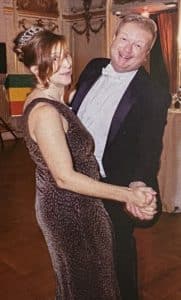
CHERISHED SYMBOL: Members and friends of the Ethiopian community in the nation’s capital joined visitors from the Palm Beach Freedom Institute to celebrate the 80th anniversary of Holy Trinity Cathedral in Addis Ababa, constructed by the late Emperor Haile Selassie to commemorate the liberation of his country from Italian forces during World War II. The final resting place of the Emperor, other members of the Imperial Family and national patriots, the Cathedral is considered the “crown jewel of the Ethiopian Orthodox Church,” the late monarch’s grandson and gala patron, Prince Ermias Sahle Selassie, told guests before a concert of traditional music, dinner and dancing to the sounds of the Alex Donner Orchestra. After noting that his country sadly remains better known for famine, oppression and civil war — “a legacy that is still rearing its ugly head” — the Prince said he hoped the Cathedral would continue to “symbolize a new Ethiopia and a new Africa” in the years to come.

CHAMPIONS OF LIBERTY: “We oppose the horrors of communism in all its forms,” Freedom Gala chairman Paul du Quenoy noted, “and are proud to honor our stalwart Ethiopian friends as they emerge from its tyranny.”

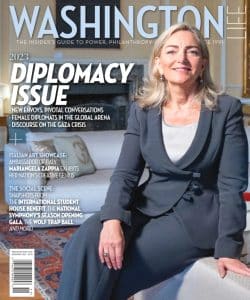
[Source: Washington Life Magazinehttps://washingtonlife.com/digital-edition/#nov2023_1]

In a Week of Honours, Ethiopian Crown Council President Receives the Freedom of the City of London

His Imperial Highness Prince Ermias Sahle-Selassie Haile-Selassie, President of the Crown Council of Ethiopia, was given the prestigious honour of Freedom of the City of London, on November 17, 2023, mirroring the similar honour given to his Grandfather, His Imperial Majesty Emperor Haile Selassie I, during his State Visit to Britain in 1954.

The honour, bestowed at the Guildhall in London, occurred in the same week that Prince Ermias paid a formal, and yet sentimentally important visit to the Emperor’s home in exile in Britain — Fairfield House, in the city of Bath — where he was received on November 14, 2023, by officials caring for the home and its grounds as a monument to the Emperor, as well as by the Mayor of Bath. The Mayor then escorted Prince Ermias and Princess Saba Kebede on a tour of the city, including the famous 2,000-year-old Roman baths, where a photograph of the Emperor still adorns the walls from his time there in the 1930s.

It was from Fairfield House that Emperor Haile Selassie worked to get British support for the war to remove the invading Italian forces from Ethiopia.

On the next day, November 15, 2023, His Imperial Highness presented and unveiled an important monumental plaque at the Royal Chapel, St. George’s Chapel, at Windsor Castle, near London. The monument paid tribute to the great victory which the Emperor, along with his British and Commonwealth allies, achieved in 1941, driving the occupying Italians from Ethiopia. This was the culmination of the work he began at Fairfield House.

While at Windsor Castle, Prince Ermias and his wife, HIH Princess Saba Kebede, paid tribute to the son of Emperor Tewedros II, Prince Alemayu, who is buried outside St. George’s Chapel. Prince Alemayu had been raised by Queen Victoria after the death of Emperor Tewedros II, and was deeply loved by the British monarch. She marked his passing by erecting a monument to him inside the Chapel, something unique in the Castle’s history, and ensuring that he was buried with the graves of some 40 or more British Royal Family members.

Prince Ermias unveiled the Victory of Gondar memorial plaque, initially, at Prince Alemayu’s gravesite. The Chapel’s Canon Jonathan Coore delivered a sermon on the occasion, speaking in English and Ge’ez, and quoting from the Book of Enoch. Prince Ermias presented him with a Victory of Gondar medal to commemorate the event and the great Ethiopian-British alliance.
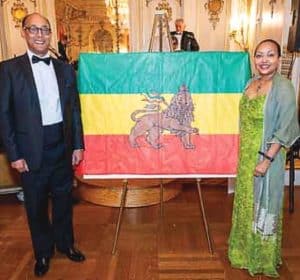
The Victory of Gondar Dinner: London: November 17, 2023

Remarks by HIH Le’ul Ermias Sahle-Selassie Haile-Selassie

President of The Crown Council of Ethiopia

Dear Friends.

Let me call you that, because nothing differentiates us tonight.

And I thank Almighty God for that.

We are here because of the bond of our love for freedom. We love Ethiopia, and crave its freedom.

And we love the Britain and her Commonwealth which helped the great Emperor, my Grandfather His Imperial Majesty Emperor Haile Selassie I, to achieve the freedom and salvation of Ethiopia.

The years of abandonment by the world scarred my Grandfather and the Ethiopian People. The Victory at Gondar — even though the world forgot it when, two weeks afterwards, Japan attacked Pearl Harbor, bringing the US into the war — … well, the Victory at Gondar began our healing, and accelerated the path by the Emperor toward making Ethiopia a true confederation of lands and people under a democratic, parliamentary constitutional monarchy, similar to the pattern of the United Kingdom.

Our path to that goal was interrupted, even as the Emperor drafted a new Constitution in 1973 to implement the final steps in this, and as my Grandfather was overthrown and then killed by the Dergue. They killed or imprisoned so many of my family and the families of so many Ethiopians, and we mourn them as we mourn the loss of the Arbegnoch — the Patriots — who gave us the Gondar Victory. And those from Britain, Kenya, Australia, and elsewhere, who lie in graves, so many unmarked graves, in the Ethiopia which has become their eternal rest.

This was an achievement not only for Ethiopia, but for the world. We celebrate the 82nd anniversary of that painful relief and victory, at Gondar, where we saw the first territory seized by the Axis powers in World War II freed from brutal occupation. We also cannot forget that the invasion of Ethiopia in 1935 was the true start of World War II. And we Ethiopians suffered, apparently without friends or support, until the relief began after 1939, and final victory for Ethiopia was delivered two years later.

But where are we Ethiopians today? I say that in all the chaos of the continuing conflict which is the legacy of that dreadful Dergue and its successor communist and autocratic governments, we are, in fact, closer to returning to the Emperor’s dream of democracy, and a unity of Ethiopian spirit than we have been for almost five decades.

HIH Le’ul Ermias Sahle-Selassie Haile-Selassie, President of the Crown Council of Ethiopia, with Le’ult Saba Kebede at Windsor Castle, in the United Kingdom, on November 15, 2023, at the gravesite there of HIH Prince (Le’ul) and Dejazmatch Alameyu, the son of Emperor Tewedros II. Le’ul Alemayu was, at the request of the Emperor before he died, taken into the care of Queen Victoria, who raised him as a son until his death in 1879 at the age of 18. Le’ul Alemayu was buried in an area with some 40 members of the British Royal Family, which is why it is now impossible to recover his remains for repatriation to Ethiopia, and why he remains at rest in his adopted country. Between Le’ult Saba and Le’ul Ermias can be seen the new Memorial Plaque to the 1941 Victory of Gondar. The plaque was unveiled at St. George’s Chapel, at Windsor Castle, the chapel of the British Order of the Garter, to which His Imperial Majesty Emperor Haile Selassie I belonged.

Why is this 82nd anniversary of the Gondar Victory so important?

This week, through the graciousness of His Majesty King Charles III — for whom we call God’s Blessing on his new reign — we were able to unveil a new Memorial Plaque at St. George’s Chapel in Windsor Castle to the memory of those who made the Gondar Victory possible. This was a major milestone, not only in modern Anglo-Ethiopian friendship, but also in recognising the strategic importance of Ethiopia to the security of the great global trade link of the Red Sea and Suez Canal. And in recognising the bonds between the Ethiopian and British crowns, which eventually became bonds between eternally linked brothers.

I was blessed, too, this week, to visit my grandfather’s home in exile, Fairfield House, in Bath, and again to reflect on his anguish as he sought a path home to relieve Ethiopia of its invaders. And then, today, I was privileged to be granted the Freedom of the City of London. All of these things are small marks on the pages of history, but they mark the slow rebuilding of the dignity, warmth, and nobility of our nations, Britain and Ethiopia, and our recognition of the importance of the Commonwealth of Nations to which we also owe brotherhood.

It is not from nostalgia that I speak. It is from the reality that today, more than ever since World War II, Britain and Ethiopia seek to restore nobility of purpose to our nations, and this is the most essential ingredient to restoring the dignity of purpose and magnanimity of the souls of all our peoples.

For us, it is critical, because Ethiopia, as I said, remains embroiled in war. The chaos which began with the regicide of my grandfather and — far worse — the destruction of the dreams of the Ethiopian People, is now approaching a climax.

The largest war in the world today, in terms of casualties and displaced persons, is not in Ukraine or the Levant — as tragically important and barbaric as those wars are — it is in Ethiopia, where possibly as many as 1.5-million people have been killed in the past year and 26-millions more have become displaced from their homes. We join the world in mourning the loss of life and the meaning of life in the Ukraine and Israeli situations, because we know the meaning of suffering.

The Ethiopian People are now fighting for their lives, their freedoms, their very identity, and the Crown of Ethiopia is in the midst of this, attempting to give support to the people, and to supporting the Ethiopian Tewahedo Orthodox Christian Church. This war — which is a genocidal attack, by the United Nations definition — goes unreported in the Western media, largely because of the suppression of the internet and news coming from Ethiopia, but I want you to know of it, and to help where you can.

In a moment, I am going to ask my kinsman, Lij Asfaw Sahle, to give you a brief report on the situation inside Ethiopia.

In the meantime, let me again thank you all for being with us tonight. It is a blessing of immeasurable comfort to me and to Princess Saba. And let me thank my friends and colleagues who have made this dinner possible. It is one of the few opportunities for us to gain attention for our cause and to raise some funds for the operation of the Crown Council.

Let me now, ending with my profound thanks to you all, call on Lij Asfaw to talk with you.