We and our colleagues of the Ethiopian Crown Council have watched in stunned disbelief the immense and unprecedented calamity that has befallen the gentle and courageous folk of America’s idyllic Gulf Coast–Florida, Alabama, Mississippi, and Louisiana. The Crown has many dear and treasured friends in the region and our heartfelt sympathy and prayers go out to them and their fellows.
We also wish to take this opportunity to offer words of encouragement, certain in the sure knowledge of the indomitable Spirit and Will of the American People to overcome and prevail over adversity.
Finally, we call upon the 700,000 resident American Ethiopian community and its organizations and leadership – churches, mosques, civic and professional groups — to offer whatever assistance they can to give back and assist our generous America benefactors during this time of extraordinary national distress.
It is with deep regret that the Crown Council has learnt of the deaths of 27 people and the many injured, during the last few days following the May 15th elections in Ethiopia. We extend our heart felt condolences to the families of all those who have lost their lives in pursuit of their ideal. The violence and deaths have shocked and diminished us all.
Like all Ethiopian citizens, we members of the Crown Council have the moral obligation to express our deep concern regarding the situation that is daily getting out of hand as we face a major crossroad in our nation’s history. May 15th was truly exemplary of a nation’s disciplined action. The lessons that we had learnt from history, our pride and resolve were all expressed with patience and dignity.
However, our hope for a major stride to honor each citizen’s inalienable rights to have the freedom of choice, the effort to ensure the acceleration of socio-economic development based on true equality, and the optimism that we could all jointly address our nation’s basic problems, are now in grave danger of fleeting away as an unfulfilled dream. The tragedy is that all this is unfolding at a time when millions of our people are once again faced with food shortage, and the international community is determined to adopt a comprehensive strategy to enable us to free ourselves from the vicious cycle.
As each and every one of us is a stake holder in the well being of our nation, we should refrain from sabotaging ourselves when we are at the brink of a breakthrough to institute democratic institutions and to find committed assistance that will help us overcome our basic problems to clear the way for a brighter future. Surely, we Ethiopians who have had long established culture of co existence of many ethnic and religious groups can seek and find a way to live with those who have different political views from us.
Thus we urge both the Government and the Opposition Parties to exercise utmost patience, flexibility and restraint in their dealings with each other and with the public at large. They both cannot afford to risk losing the measure of trust placed on them by their respective constituencies. While we keep in mind that democracy is one of our nation’s most noble goals, we must at the same time realize that democracy is not born overnight, or without some measure of compromise. As one life lost through impatience and inflexibility is one life too many, all Ethiopians should place precedence in the rule of law and fundamentally accepted standards of human rights.
Most of all, we plead to all political groups to refrain from igniting ethnic and other differences to secure short term political gains. If these divisive actions are practiced, they will add fuel to the fire that will consume our people, and make us all major losers. The media and the general public also have moral obligation to be cautious not to spread distrust and fear. If we manage to pull ourselves back from the brink of deep despair that is hovering over our nation, and find a method of working together, the next five years can usher in a new era of democratic growth and build the base for stability in Ethiopia.
Statement given by HIH Prince Ermias Sahle Selassie, Chairman of the Crown Council of Ethiopia, on the passing away of His Holiness Pope John Paul II.
During the past few weeks, the Ethiopian Crown Council had joined Roman Catholics, Christians of all denominations, and, indeed, all mankind throughout the world in mourning the passing away of His Holiness Pope John Paul II. His passing is an immeasurable loss to all humanity who had amply demonstrated their great admiration, high respect and deep love during the period of mourning and at His funeral.
As we reflect on our great loss, we need to draw strength form the enlightenment, courage and true joy that His Holiness shared with all of us without drawing any boundary of denomination, faith or philosophy. During his Papacy, His Holiness demonstrated true courage and humility when he asked for forgiveness as he believed that this is the basis for true reconciliation and lasting peace. He readily granted forgiveness when he sat face to face with the man who tried to kill him and gave him absolution. He traveled throughout the world to promote a truly inclusive society, to bring attention to the case of those who have been marginalized, and acted as the voice of the voiceless.
We Ethiopians will remember His Holiness particularly for his tireless campaign to alleviate poverty and to promote a more just and compassionate world. Ethiopian Christians, Muslims and Jews who have peacefully lived together for many centuries fully appreciate the importance of His Holiness’s message of coexistence. In this most challenging period of world history, His Holiness Pope John Paul II showed us the pathway from hate to love, from division to unity, from war to peace, and, indeed, from darkness to light. His Holiness Pope John Paul II will truly be missed.
Upon the election of Pope Benedict XVI, the Ethiopian Crown Council wishes to extend its warm greetings and best wishes to the new Pope. We pray that God, in His infinite wisdom, will guide Pope Benedict XVI as he continues to carry forward God’s work.
May Pope John Paul II rest in Peace, and may Almighty God bless and guide Pope Benedict XVI.
Statement Given by HIH Prince Ermias Sahle Selassie and HIH Prince Bekere Fikre Selassie, on the Occasion of the Month Long Celebration of Bob Marley’s 60th Birthday, in Addis Ababa, Ethiopia
As the leaders of the Crown Council of Ethiopia, we would like to acknowledge the fact that what the Bob Marley Foundation has achieved in Addis Ababa, during the first two weeks of February 2005, is truly amazing! Who would have believed, even a few months ago, that Bob Marley, who has been deeply inspired by our late grandfather Emperor Haile Selassie I, would receive such high honor and public recognition in the presence of a few members of the Imperial family, Prime Minister Meles Zenawi, the Patriarch of the Ethiopian Orthodox Church, Leaders of all other Christian Denominations, Leaders of Muslim Faith, the Mayor of Addis Ababa, as well as Representatives of International Organizations, all in front of over 250,000 people!
It is a credit to Bob Marley’s memory that he has became the reason for once again hosting with pride the traditional Ethiopian Flag with the lion, which many African States and the Rastafarian Movement had modified and used as the symbol of African pride and independence. It is also in remembrance of Bob Marley that the photograph of Emperor Haile Selassie I was displayed with sentiment and respect in a country which had underrated and suppressed both the meaning of the flag and the contribution of the Emperor, since the 1974 revolution. The debate organized for African youth during the celebration so that they may consider how best to prevent massive brain drain, in order to facilitate social and economic development in our continent, is, indeed, an invaluable contribution. We hope that the steps taken to reconcile the Diaspora with the continent of their heritage will also have long lasting benefits. Furthermore, the revival of the spirit of African Unity is a reminder of the aspirations and the contributions of many Pan Africanists from all over the world, who had strived not only for territorial independence, but also for social and economic justice, which regrettably Africa is yet to achieve.
However, like many Ethiopians we are perplexed that while Bob Marley’s lyrics continues to re-affirm the historic significance of Ethiopia as a symbol of African civilization, pride and independence, the contribution of those who have inspired Bob Marley, particularly that of Emperor Haile Selassie I, and the Ethiopians Patriots who have safeguarded the unity and independence of our country, have not been accorded equal recognition and respect by their own compatriots. As we aim to sustain the dignity of Africans, we need to uphold historical integrity by teaching our youth that it is the sacrifice, courage, and united action of Ethiopian leaders and their people throughout the ages that has inspired Bob Marley. Our youth also need to be made aware, that Ethiopia deserves the credit for having inspired many African leaders, especially since the battle of Adawa in the late 19th Century to struggle and regain the independence of their respective countries.
Historical integrity also demands that we acknowledge the fact that Emperor Haile Selassie’s contribution as a Statesman, goes far beyond the fact that he was the source of the inspiration that lead to the establishment of the Rastafarian Movement. We believe that Bob Marley’s call for brotherhood and unity has opened the door for the people of the world, particularly Ethiopians, to weigh with outmost objectivity Emperor Haile Selassie’s achievements against his shortcomings, which he as a human being undoubtedly had. In doing so, however, we must judge him in the context of the ideological and material situation that prevailed in Ethiopia and the world in his time.
Since the 1974 revolution, much has been said about Emperor Haile Selassie’s failings. As the leaders of the Crown Council of Ethiopia, which in July 2004, decided to become a non-political organ of the Ethiopian Crown, it is our historic duty and honor to remind Ethiopians and the world at large, about the major achievements of the Emperor.
Emperor Haile Selassie was a pioneer who had done his outmost to move Ethiopia from the feudal age to the 20th Century. He had granted a modern Constitution by which his people are to be governed. He promoted the establishment of modern education and health care, so that they may benefit from advancements in the world. He instituted a central judicial system that is removed from political interference. He installed a modern system of banking and centralized taxation to bring his country to world standard. He also founded the Ethiopian Telecommunication Authority and Ethiopian Airlines to give his people exposure to the world. The main infrastructures that are found in Ethiopia today and also many educated Ethiopians are the product of his contribution. At the re-internment of the Emperor’s remains, in November 2000, the Patriarch and all the leaders of the Ethiopian Orthodox Church had borne witness regarding the Emperor’s tremendous contribution as the defender of the faith.
The world can not deny the fact: that Emperor Haile Selassie was the one who abolished slavery in Ethiopia; that he led his people in defending and securing Ethiopia’s independence during World War II; that he was highly distinguished for his foresight, courage and dignity in advocating collective security at the League of Nations, (an issue that still preoccupies the world); that he was magnanimous in giving immediate amnesty to the remnant of the Fascist Army; that Emperor Haile Selassie gave support and encouragement to Leaders of African Liberation Movements, such as Jomo Kenyata, Julius Neyrere, and Nelson Mandela; that he played a major role in establishing the Organization of African Unity, which even today remains as the African Union with its Headquarters still in Addis Ababa; and that the Emperor had made remarkable contribution as a mediator in conflict resolution in Africa. Thus, we owe it to succeeding generations to present a total picture of Emperor Haile Selassie’s history which far transcends the recognition accorded to him as the father of the Rastafarian Movement.
In line with the above, as Ethiopians and Rastafarians pledge to build a monument to Bob Marley in Addis Ababa in respect of his message, it is only fitting that they should also honor the source of Bob’s message by constructing a worthy monument of Emperor Haile Selassie I, and Ethiopia’s many unsung heroes, our nation’s Patriots. In the spirit of true unity advocated by Bob Marley, it is also our responsibility to remind our Rastafarian brothers and sisters that Emperor Haile Selassie, who was a devout Christian, has never claimed to be a deity. In fact, the Emperor was responsible for establishing the Ethiopian Orthodox Church in the Caribbean.
We extend our most sincere thanks to the Rastafarian community for honoring their African heritage; for preserving part of Ethiopia’s history in artistic and photographic form; for upholding the memory of Emperor Haile Selassie I; for their offer to help build a Museum in Addis Ababa, to house Imperial Ethiopian heritage. Above all, we thank them for re-kindling the spirit of Africa unity and reconciliation, that is inline with the vision of our forefathers who strove for political, social and economic justice. As we follow in their footsteps, we need to have courage and integrity to recognize that we ourselves have to take the lead role in becoming masters of our continent’s destiny.
The Imperial Society of St George of Lalibela has applied for tax-exempt status. Donors may pledge the amount they intend to donate and send in their contribution once the tax exempt status has been issued.
His Imperial Highness Prince Ermias Sahle-Selassie Haile-Selassie
President of the Crown Council of Ethiopia
Ethiopia is a beautiful mosaic of cultures, faiths, and many lifestyles. It is the home of Christians, Muslims, and Jews, as well as those of various traditional beliefs. Ethiopia is also a land of amazing beauty. Our mountains, valleys, and rivers are a wonder to behold. God and nature have richly endowed our country, that even visitors feel an inexplicable spirituality while there.
Ethiopian civilization represents the longest unbroken chain of cultural continuity in the history of the world. The rift valley is the home of Denkinesh – who is known to the world as Lucy – the earliest humanoid, and thus, the cradle from where human society first emerged. Ethiopia is also a country that is the custodian of the Ark of the Covenant. The worldwide Christian community considers Ethiopia as an illustrious realm mentioned in the Bible more than 40 times. Furthermore, our country is world renown as the land where the Solomonic Dynasty of the Ethiopian Crown had served at the helm of Ethiopian society for centuries. The Prophet Mohammad called Ethiopia “the land of righteousness” and ordered his followers never to provoke Ethiopia. Thus, as there is a direct link between Ethiopia and the biblical world of Jews and Christians, so is there a direct link between Ethiopian society and the very foundation of Islam. Ethiopian civilization is, therefore, a world treasure of great importance, as it is the root of Judeo-Christian civilization as well as the fabric of Muslim society.
Ethiopia is a country that has withstood the ravages of periodic war, famine and revolution. Our people fought gallantly the Italians at Adawa, and Machew, to uphold the dignity of people of African heritage which made Ethiopia the source of African identity and the beacon of African Independence. At the inauguration ceremony of the Organization of African Unity, H. E. President Julius Neyrere stated that Africans who had previously accepted European domination as a given, learned from Ethiopia that it is possible to fight, and even to win the fight!
Ethiopian culture is a relic of ancient times and at the same time alive and vibrant. It has been, and continues to be enriched by its diverse heritage, which has made it full of promise, and great potential. Ethiopians in the Diaspora have transplanted our rich cultural heritage to help us maintain our identity, and to sustain us in our new home of refuge. In return, we have all learned, and gained tremendous experience living in all corners of the world – from London to Sydney. If encouraged and accepted, we can utilize our human and material resources to help modernize our country.
The preservation of Ethiopia’s cultural heritage and the transmission of its oral history and customs, were threatened with annihilation by the violent tidal wave of the 1974 coup d’etat and the Dergue’s subsequent purges and genocidal acts. After this wave receded, and the global Cold War had ended, another wave – this time of globalization – began to wash over the world, including Ethiopia, before our country could regain its sense of identity and restore its damaged treasures. Thus, I believe that the church and the Crown Council, together with other concerned groups, have the responsibility to put back the pieces in the mosaic of history, so that Ethiopia can continue to play its intrinsic role in the world community.
Dear readers, I have narrated facts which are well known to most of you, to express the immense pride and love that I have for my country. These facts are also reiterated as a backdrop to show what has inspired me and members of the Crown Council to change our focus from the realm of politics to cultural preservation, environmental conservation, social development and humanitarian programmes, which are the overriding needs of our society. It is, indeed, my deep concern for my country, and my sincere belief that the Solomonic dynasty has the historic responsibility and moral obligation to be of continued service to the Ethiopian people, that has helped me to translate my dream into viable programmes. In this way, the Crown will continue to be of service to the Ethiopian people.
The plan to establish the Imperial Society of St. George of Lalibela was first conceived in 1994, a year after HIM Ameha Selassie reconstituted the Crown Council in Exile, and appointed me as its Chairman. The work of the Society was, however, launched on July 24th, 2004. The delay in initiating the work was due to many factors. Those of us who were appointed to serve on the Crown Council needed time to familiarize ourselves with the tremendous responsibilities that were entrusted to us. Since we assumed our posts without any financial backing, and we had to at the same time earn our living, volunteers had to be found to help us initiate some projects that are relatively self contained and did not require most of our time, such as the Scholarship Programme granted to 24 Ethiopian Students by the Pacem In Terris Programme, of La Roche College, Pennsylvania. Priority was also given to first support development programmes.
The success of the Scholarship and other Programmes implemented by the Haile Selassie Fund for Ethiopian Children, the warm reception that I received during my brief return to Ethiopia in the year 2003, had convinced me that the Ethiopian Imperial family still has an important nonpolitical role to play in Ethiopian affairs. With this in mind, we registered a branch of the Haile Selassie Fund for Ethiopian Children in Addis Ababa, Ethiopia, in May 2004.
The overriding Cultural Role of the Crown Council is to promote reconciliation, peace building, and national unity. While the Haile Selassie Fund for Ethiopian Children will support environmental conservation, social development, and humanitarian programmes, the Imperial Society of St. George of Lalibela will give support to preserve Ethiopian History, uphold Ethiopia’s religious heritage, and maintain the history and dignity of the Crown. These programmes were formulated to be complementary, so that they may jointly carry forward the legacy of HIM Emperor Haile Selassie I, who was in the frontline in preserving Ethiopia’s ancient heritage, and at the same time, in modernizing his country.
The launching ceremony of the Imperial Society of St. George of Lalibela, and the commemoration of the 112th Birth date of HIM Emperor Haile Selassie I was organized together with the Annual Meeting of the American College of Heraldry, on July 23-24, 2004, at Charleston, South Carolina. This booklet records the events that took place before and during the launching ceremony. It also shows some samples of Ethiopian heritage that need to be preserved. The samples presented were used because they are conveniently available for publication. The aim of the Society is, however, to promote that every cultural heritage in Ethiopia be given equal recognition and that they also be well recorded to help maintain the dignity of all the people in the country.
One of the objectives of this booklet is to explain in full the purpose and goals, as well as the structure, of the Imperial Society of St. George of Lalibela, to help introduce the Society to the worldwide public. It will also serve as a guideline for the members of the Society who wish to establish Chapters in other States in the US, and in other countries around the world. As membership in any viable Society should be a dynamic one, the content of the booklet is only a foundation on which the members can build. The members should expand the objectives of the Society, if and when needed, so as to ensure the achievement of its goals at all times.
The cultural heritage of different linguistic groups in Ethiopia will be presented at each annual meeting of the Imperial Society in the US. We hope that this will promote further understanding and appreciation of each other’s cultural heritage, and thereby strengthen national unity. Furthermore, the members of the Society will be encouraged to find support for preserving indigenous cultures which have hitherto been neglected, and/or not sufficiently recorded. The use of modern technology to record and preserve oral history, ancient poetry, and songs will thus be supported.
The major raison d’etre of the booklet is to show that the true history of a nation includes the history of all the people in the country; the major contributors to the well-being and dignity of the nation; all religions practiced in the country; as well as that of all Monarchs of different lineages, and of other leaders who have served at the helm of Ethiopian society. Thus it embraces the entire population of Ethiopia and promotes an inclusive sense of national unity. This has been, and will continue to be, the role of the Ethiopian Crown.
Furthermore, it is intended that the booklet should serve as an educational tool to teach all Ethiopians – particularly the younger generation – that Ethiopia has an ancient heritage in which all its people should continue to take pride. The people also need to be made aware that it is the nation’s dignity and honor, derived from our ancient heritage, that had enabled succeeding generation of Ethiopians to weather the storms of frequent war and famine.
In addition, the booklet is used to transmit important messages of deep concern related to upholding the nation’s ancient heritage. It alerts our people to alarming erosion of our country’s long-established culture of tolerance, and coexistence of many linguistic and religious groups. It emphasizes the moral obligation of the educated groups to share their knowledge with their fellow countrymen, and to provide effective leadership at all levels of society. The need to involve the beneficiaries in planning and implementation of projects designed to alleviate their problem is also emphasized. Furthermore, by outlining the value of Ethiopia’s historical heritage, we hoped that the booklet will encourage Ethiopians to be more involved in cultural preservation.
One serious matter that I am deeply concerned about, and that should concern all the people of Ethiopia, is the ongoing pillaging of historic documents and artifacts. The archives of various national institutions are being emptied, and invaluable documents and artifacts are sold in the streets of Addis Ababa and other towns, leading to erosion of Ethiopian history. Thus, I call on educators at all levels, including members of the press and radio, to join hands with us to inform the public regarding the danger of such practice.
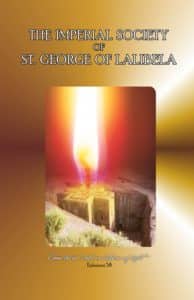
The design of the front cover of this book was prepared by two brothers, Ermias and Endrias Hailu Zewede, who received their University education in the US through the Scholarship Programme granted by the Haile Selassie Fund for Ethiopian Children. It depicts the dream which I actually had in which I saw the border of the Church in Lalibela illuminated by three rows of candles. In preparing the design for the booklet, it was, however, decided to use only one candle for aesthetic purposes.
May we all “Walk as the Children of Light.”
Prince Ermias Sahle-Selassie Haile-Selassie, Co-Patron of The Imperial Society
The Crown Council of Ethiopia is pleased to announce that a comprehensive book about the Imperial Society of St. George of Lalibela has been prepared and posted on the Society’s website. Click HERE to read the Foreword to this important publication.
The Foreword highlights that Ethiopia has a deep rooted spiritual, cultural and historical heritage that represents the longest unbroken chain of cultural continuity in the history of the world. This has enabled it to uphold the dignity of people of African heritage and to become the source of African identity and beacon of African independence. As it is the root of Judo-Christian heritage as well as the fabric of the Muslim faith, Ethiopian culture is a world treasure that must be preserved. Concerns regarding the erosion of Ethiopian cultural heritage are expressed and some corrective action are proposed.
The Foreword also stated that the raison d’etre for publishing the book is to show case that the true history of a nation includes the history of all the people in the country; the major contributors to the wellbeing and dignity of the nation; all religions practiced in the country’s boundaries; as well as that of all Monarchs of different lineage, and of other leaders who have served at the helm of Ethiopian society. Thus it embraces all Ethiopian people in its inclusiveness and promotes national unity, which has been and continues to be the role of the Ethiopian Crown.
In addition, on behalf of all Ethiopians past and present as well as of future generations, the Crown Council of Ethiopia most gratefully acknowledges and extends its heartfelt thanks to all those who have saved written and photographic record of Ethiopia’s ancient heritage. It says that what they have preserved will help future generations of Ethiopians maintain their national pride and identity, assured in the knowledge that their culture has contributed to the beautiful mosaic of world heritage. All Ethiopians are, indeed, most indebted to each and every one of them.
It is with great joy that the Patron of the Haile Selassie Fund for Ethiopian Children, Prince Ermias Sahle Selassie, announces that two of the recipients of scholarship from the Foundation, namely the two brothers Ermias and Endrias Hailu Zewede have been recognized on the year 2003, “Who’s Who Among Students in American Universities and Colleges.” (Volume 69, Page 1315 and 1316.)
The Book is a an annual publication that presents “A Biographical Compilation of the Year’s Most Outstanding Men and Women in American Universities and Colleges.” Ermias and Endrias Hailu Zewede have been recognized for their all round accomplishment in academics, sports and social services.
Since then, the two brothers had secured two posts as Assistant Lecturers at the University of Southern Carolina, where they have now completed one year of their Masters Degree. The brothers who are both Graphic Designers say that their main objective is to portray Ethiopia in good light – a service that is much needed!
Prince Ermias extends his heart felt Congratulation to Ermias and Endrias. Sincere Congratulations also go to their parents Ato. Hailu Zewde and Weizero Demekech Habtewold for having brought-up such fine young men whose love, diligence and community spirit complements their God given talents. Prince Ermias said “Those who had helped to select the scholarship students and all those who had taken part in their education should take particular satisfaction in a job well done! Ermias and Endrias have made us all proud!”
The Crown Council of Ethiopia regrets to announce that, the Chairman of the Crown Council, HIH Prince Ermias Sahle Selassie and his wife Wizero Gelila Fesseha, have been separated since April 2003. Further developments will be announced in due course.
Since the Foundation known as The Haile Selassie Fund for Ethiopian Children operates under the umbrella of the Crown Council of Ethiopia, the Crown Council also hereby announces that Wizero Gelila Fesseha is no longer the Co-Patron of this Foundation.
The Haile Selassie I International Development Foundation, which made its debut at the celebration of the centennial of Ethiopian/American relations, at Howard University, On March 25th 2004, is neither a part of, or is it associated with the Haile Selassie Fund for Ethiopian Children. The later Foundation works under the Crown Council of Ethiopia and is chaired by HIH Prince Ermias Sahle Selassie.
It is also to be noted that the e-mail address given by the Haile Selassie I International Development Foundation as haileselassiefund.org, has no connection with the Haile Selassie Fund for Ethiopian Children, which is often referred to, in short, as the Haile Selassie Fund.
In view of the confusion created by the Haile Selassie I International Development Foundation, the Crown Council of Ethiopia considers it as its duty to advice the general public worldwide, to always verify the source of information whenever approached by a Foundation that is said to be established in the name of HIM Emperor Haile Selassie I.
The Crown Council and Haile Selassie Fund for Ethiopian Children can be reached at: Fax Number 1-843-795-9845. E-Mail Address: info@ethiopiancrown.org.
We use cookies on our website to give you the most relevant experience. By clicking “Accept All”, you consent to the use of ALL the cookies. However, you may visit "Cookie Settings" to provide a controlled consent.
This website uses cookies to improve your experience while you navigate through the website. Out of these, the cookies that are categorized as necessary are stored on your browser as they are essential for the working of basic functionalities of the website. We also use third-party cookies that help us analyze and understand how you use this website. These cookies will be stored in your browser only with your consent. You also have the option to opt-out of these cookies. But opting out of some of these cookies may affect your browsing experience.
Necessary cookies are absolutely essential for the website to function properly. These cookies ensure basic functionalities and security features of the website, anonymously.
Cookie
Duration
Description
cookielawinfo-checkbox-advertisement
1 year
Set by the GDPR Cookie Consent plugin, this cookie is used to record the user consent for the cookies in the "Advertisement" category .
cookielawinfo-checkbox-analytics
11 months
This cookie is set by GDPR Cookie Consent plugin. The cookie is used to store the user consent for the cookies in the category "Analytics".
cookielawinfo-checkbox-functional
11 months
The cookie is set by GDPR cookie consent to record the user consent for the cookies in the category "Functional".
cookielawinfo-checkbox-necessary
11 months
This cookie is set by GDPR Cookie Consent plugin. The cookies is used to store the user consent for the cookies in the category "Necessary".
cookielawinfo-checkbox-others
11 months
This cookie is set by GDPR Cookie Consent plugin. The cookie is used to store the user consent for the cookies in the category "Other.
cookielawinfo-checkbox-performance
11 months
This cookie is set by GDPR Cookie Consent plugin. The cookie is used to store the user consent for the cookies in the category "Performance".
viewed_cookie_policy
11 months
The cookie is set by the GDPR Cookie Consent plugin and is used to store whether or not user has consented to the use of cookies. It does not store any personal data.
Functional cookies help to perform certain functionalities like sharing the content of the website on social media platforms, collect feedbacks, and other third-party features.
Performance cookies are used to understand and analyze the key performance indexes of the website which helps in delivering a better user experience for the visitors.
Analytical cookies are used to understand how visitors interact with the website. These cookies help provide information on metrics the number of visitors, bounce rate, traffic source, etc.
Cookie
Duration
Description
_ga
2 years
The _ga cookie, installed by Google Analytics, calculates visitor, session and campaign data and also keeps track of site usage for the site's analytics report. The cookie stores information anonymously and assigns a randomly generated number to recognize unique visitors.
_ga_Q5FZW1LZTR
2 years
This cookie is installed by Google Analytics.
CONSENT
16 years 2 months 24 days 6 hours
YouTube sets this cookie via embedded youtube-videos and registers anonymous statistical data.
Advertisement cookies are used to provide visitors with relevant ads and marketing campaigns. These cookies track visitors across websites and collect information to provide customized ads.
Cookie
Duration
Description
IDE
1 year 24 days
Google DoubleClick IDE cookies are used to store information about how the user uses the website to present them with relevant ads and according to the user profile.
test_cookie
15 minutes
The test_cookie is set by doubleclick.net and is used to determine if the user's browser supports cookies.
VISITOR_INFO1_LIVE
5 months 27 days
A cookie set by YouTube to measure bandwidth that determines whether the user gets the new or old player interface.
YSC
session
YSC cookie is set by Youtube and is used to track the views of embedded videos on Youtube pages.
yt-remote-connected-devices
never
YouTube sets this cookie to store the video preferences of the user using embedded YouTube video.
yt-remote-device-id
never
YouTube sets this cookie to store the video preferences of the user using embedded YouTube video.